

You wouldn’t make an offer on a house without knowing what it’s worth.
Same rule applies to a racehorse.
But at auctions, people forget that. They see a nice-looking horse, hear a few good things and start bidding. No plan. No price target. No real explanation.
That’s not investing. That’s guessing.
If you can’t explain in two short sentences why a racehorse is worth what you’re about to spend, stop. You’re not ready to bid.
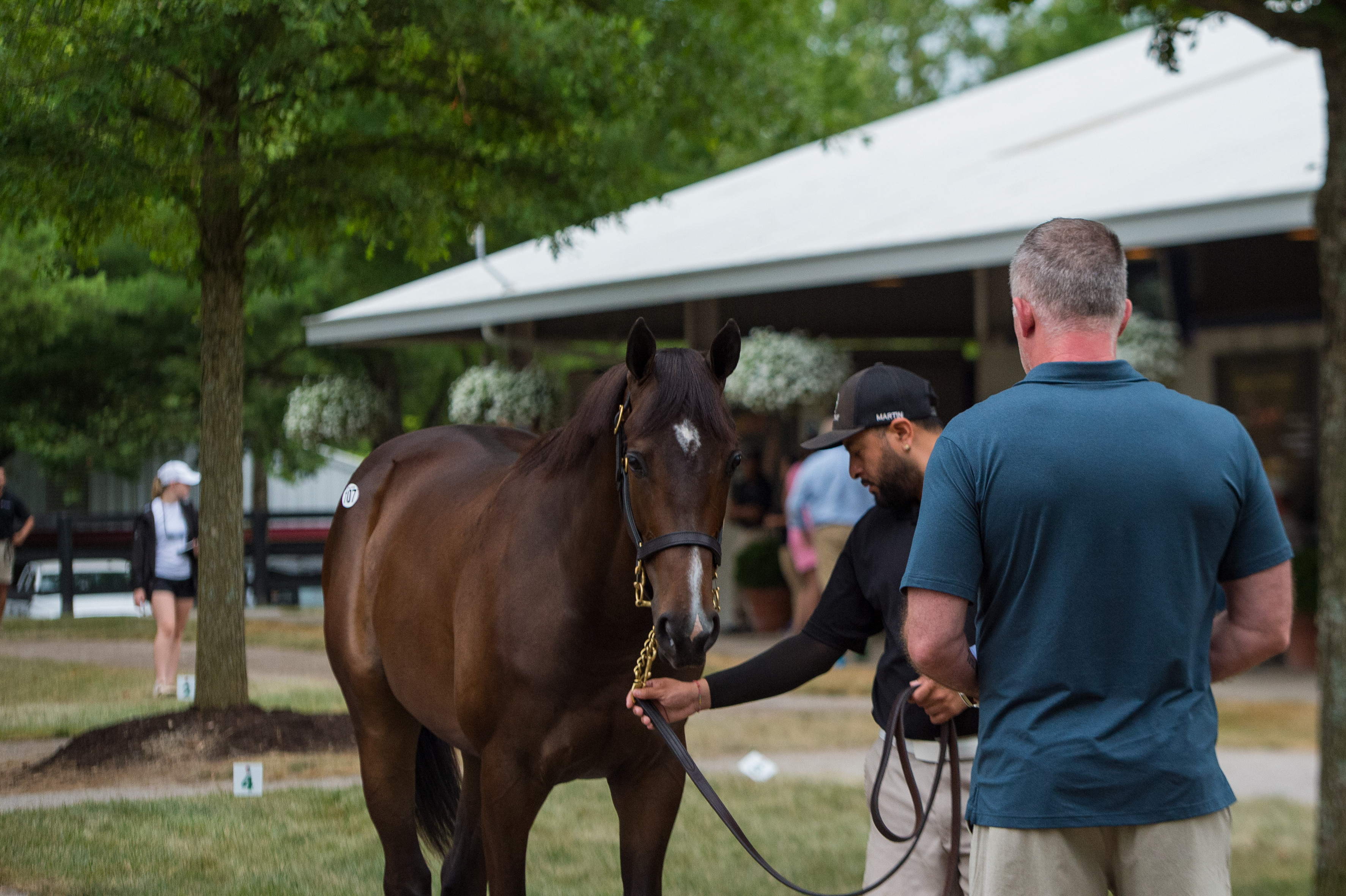
Why It Matters
When the horse walks into the ring, the pace picks up. There’s no pause button. That means your thinking has to happen before the sale.
The best buyers walk in with a number and a reason. They’ve already done the work. They don’t get pulled into the moment.
That’s what keeps them from overpaying. That’s what helps them buy better horses.
You can do the same.
Step 1: Understand What Drives Price
Every racehorse’s value at auction comes down to three key things:
- Pedigree – What the sire, dam and close family have produced on the track.
- Physical Build – Is the horse put together in a way that supports racing soundness and athleticism?
- Market Comps – What are similar racehorses bringing at this sale, this week?
Here’s an example of how a smart buyer explains a $250K racehorse:
“He’s by Constitution, whose colts are averaging $270K at this sale. The dam’s first runner broke its maiden at Gulfstream. This colt has a deep hip, strong walk and others like him have gone in the $240–265K range.”
It’s specific. It’s grounded. And it helps you stay disciplined.
Step 2: Set Your Number Ahead of Time
Never decide your limit in the ring. It’s too fast, too loud and too easy to justify something you’ll regret.
Your number should be locked in before the horse walks in.
And you should be able to explain why that’s your number. Not just say “it feels right.” That’s not a reason.
If you can’t say why you’d stop at $250K, you probably won’t.
Step 3: Prepare a One-Pager for Every Racehorse You Might Bid On
This is where discipline starts. Before the sale, write a simple one-pager for each racehorse on your shortlist.
Here’s what it should include:
- Pedigree Summary – Sire, dam, major runners from the family.
- Physical Notes – What you saw: strengths, concerns, walk, build.
- Comps – Recent sale prices for racehorses with similar profiles.
- Two-Sentence Valuation – A short, clear statement of why this horse is worth your bid.
If you can’t write those two sentences, don’t bid. You’re not ready.
What to Avoid at the Sale
- Bidding Because Others Are
Just because someone else is bidding doesn’t mean they’re right. - Overvaluing a Single Strength
A great walk doesn’t make up for a weak page. A strong page doesn’t excuse bad conformation. Look for alignment. - Reacting to the Pace of the Sale
Sales are designed to feel fast. That doesn’t mean you have to rush. Stick to your sheet. - Accepting Vague Explanations
“This one has presence.” “She just looks the part.” If you hear that, ask: What does that actually mean? If no one can explain, move on.
How to Get Better—Fast
- Pick 5 Horses Before the Sale Starts
Visit them, take notes and write your two-sentence value summary. Then watch what they bring in the ring. - Track Your Results
Were you close? Way off? What did the market value more than you did? - Keep a Log of Comps
Same sire, same build, same sale. What are they going for? Build your own reference sheet.
Final Thought
If you can’t explain why a racehorse is worth $250K, don’t raise your hand.
Auctions are built to make people act fast. The winners are the ones who prepare ahead of time.
So next time you’re at a sale, don’t chase the horse everyone’s watching. Don’t talk yourself into a bigger number just because someone else is bidding.
Walk in with a plan. Walk out with no regrets.
That’s how smart racehorse investors play the game.




Hey Clark. Thoughtful writing as usual. Maybe the one thing I would change in approach is that while the 3 initial factors are essential in the marketplace – pedigree, build, comps – another category might be ‘My Angle’. i.e What am I trying to do to get the right outcome for me (right horse for me, right price). So if my goal is tor buy a yearling to race on the turf at Colonial and the mid-Atlantic, it will bias (likely favorably) certain horses that won’t be by fashionable sires (e.g. like English Channel) allowing for a better horse for the price who can meet mygoal. (also great turf opportunities at places like KD, plus ever-present at top tier venues) Or a targeted state bred program, like NY maidens that have received a big boost in purses, making them more ‘affordable’ not just walking out of the ring, but 15 months in perhaps. Or even a short distance speedster that can’t run 6f but can dominate at 4.5f at places like Charles Town or in Turf sprints. especially if state bred incentives kick in.
I think some of those angles can make a horse ‘affordable’ because the basic orientation may be quite different for the rest of the buyers, who don’t want what you’re looking for. And it really steers one away from that impulse buy as there are far fewer that meet those additional goal criteria.
just a thought.
bob
Thanks Bob!